

It’s 2 a.m. in Sterling Heights, the furnace has been running for hours, and a chirp from the hallway ceiling wakes you. Is it the battery, an old alarm, or something worse? Michigan homeowners hear this question every fall, and the rules behind it are a mix of state law, building code, and fire-safety guidance. Here’s what applies to your home, and how our smoke and combo detector installation fits in.
What Michigan actually requires
Michigan’s carbon monoxide law, MCL 125.1504f (known as the Overbeck law), provides for at least one operational, approved CO device in three situations: initial construction of a home, renovation of an existing single-family home where a permit is required, and the addition or creation of a bedroom. “Approved” means listed to UL 2034 or UL 2075 and installed per the manufacturer’s instructions.
The statute says the device belongs near the bedrooms, in areas adjacent to an attached garage, and adjacent to fuel-burning appliances. It may be battery-powered, plug-in, or wired into the home’s AC power with battery backup.
That doesn’t mean an older home with no permitted work is exempt from good practice. Michigan’s fire officials recommend working alarms in every home, whatever the code says. For new work, your local building department enforces the Michigan Residential Code, so confirm what applies at your address.
What the state fire bureau recommends
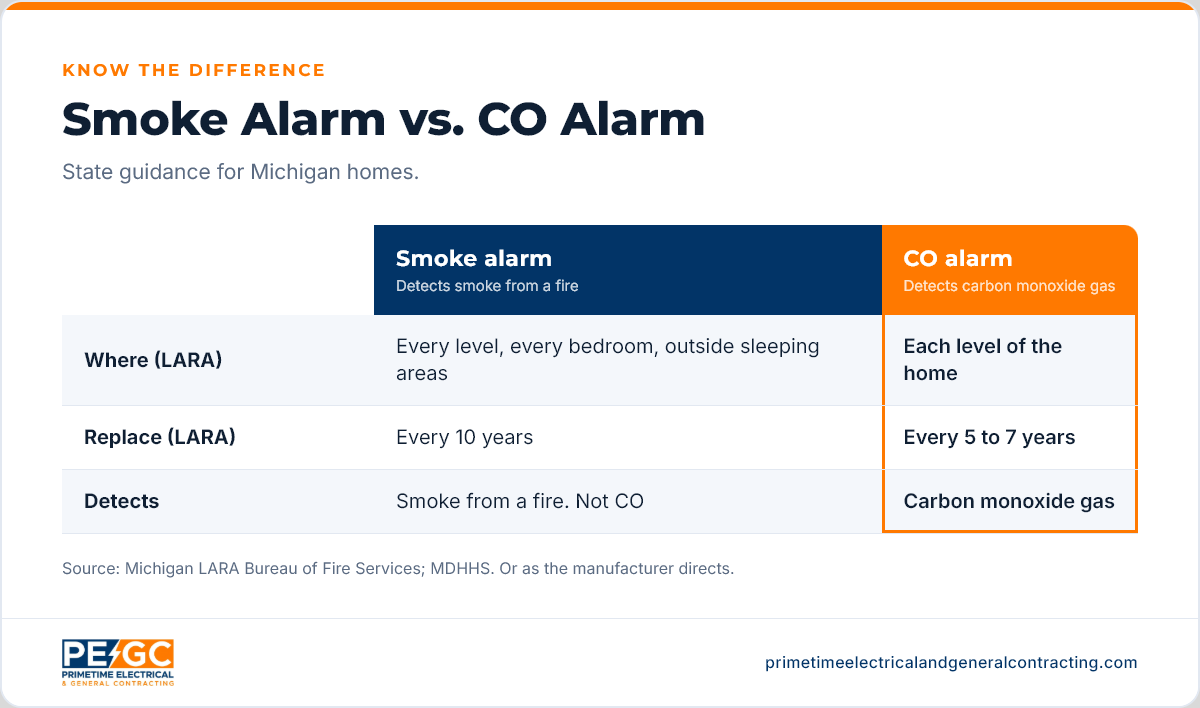
The Michigan Department of Licensing and Regulatory Affairs (LARA) and its Bureau of Fire Services recommend:
- Smoke alarms on every level, inside every bedroom, and outside sleeping areas.
- CO alarms on each level of the home.
- Hardwired alarms, or alarms with 10-year lithium batteries.
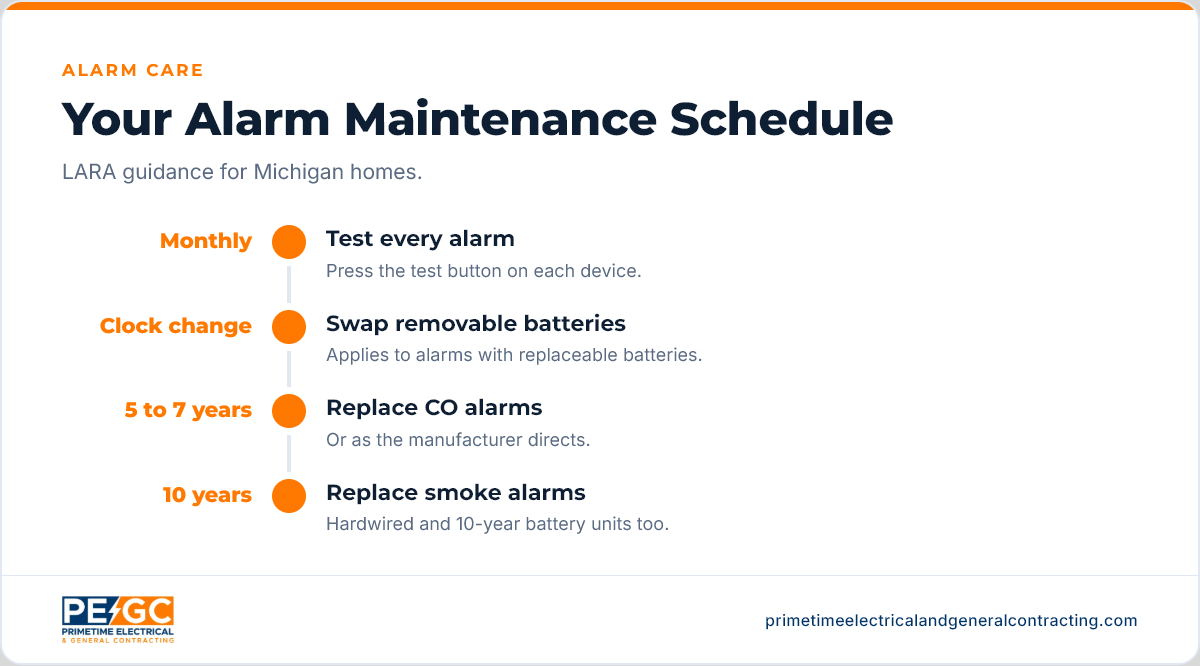
- Testing monthly, and replacing smoke alarms every 10 years and CO alarms every 5 to 7 years, or as the manufacturer directs.
LARA also cites the National Fire Protection Association: three out of five fire deaths in U.S. home fires happen in homes without working smoke alarms or where alarms were disabled or missing. This is guidance, not law, but it’s the standard we recommend for every home we visit.
Smoke alarms don’t detect carbon monoxide
This is the most common mix-up. Michigan health officials state plainly that smoke detectors do not alert to CO exposure. CO is a poisonous gas you can’t see, taste, or smell. It comes from burning natural gas, propane, wood, gasoline, and other fuels, and all fuel-burning items, including vehicles and portable generators, release it. Opening windows or doors does not stop it from building up.
If a CO alarm sounds, get outside into fresh air and call 911. Don’t try to find the source first. Combination smoke and CO alarms cover both hazards in one unit, and many homeowners choose them to simplify installation.

Hardwired, battery, or combo?
All three can be legitimate. Hardwired alarms with battery backup draw power from the house wiring, and interconnected models sound together throughout the home. Sealed 10-year lithium battery alarms can be easier to add to older homes where running new wiring is difficult. Which fits depends on your ceilings, your panel, and your budget.
Adding or altering electrical wiring takes a permit in Michigan. The Bureau of Construction Codes (LARA) requires a permit applicant to be a licensed electrical contractor, or a homeowner doing the work personally in an owner-occupied single-family home. Our crew works across Macomb and Oakland County communities. If an alarm keeps chirping or tripping despite fresh batteries, our electrical troubleshooting service can trace the cause.
Winter outages raise the stakes
CO risk climbs when the power goes out and generators come out. Michigan agencies advise running portable generators at least 20 feet from enclosed structures. If you’re planning backup power, read our guides on whether you need a transfer switch for a whole-house generator and how big a generator you need.
Smoke and CO detector FAQ
Do I need a CO detector in my existing Michigan home?
The statute’s requirement applies to new construction, permitted renovations of existing single-family homes, and new bedrooms. State agencies still urge CO alarms on every level, so we recommend one regardless.
How often should I replace my alarms?
LARA advises replacing smoke alarms every 10 years and CO alarms every 5 to 7 years, or per the manufacturer. The manufacture date is usually printed on the back of the unit.
Where shouldn’t I put a CO alarm?
Follow the manufacturer’s instructions. LARA’s advisory adds to avoid very humid areas and spots within 15 feet of fuel-burning heating or cooking appliances.
Can I install a hardwired alarm myself?
Wiring work needs a permit, and only a licensed contractor or a qualifying owner-occupant may pull it. Most homeowners hire a licensed electrician.

Not sure what your home has? Primetime Electrical offers a free estimate on smoke and CO alarm installation. Call (810) 397-2401 or request your estimate online.