
It’s a hot July evening in Sterling Heights. A thunderstorm rolls in, the lights blink once, and everything comes back on. You think nothing of it until the next morning, when the garage door opener won’t respond and the microwave display is dead. Nothing was struck by lightning. Nothing even smelled burnt. But something on your electrical system gave up, and a power surge is the usual suspect.
So is a whole house surge protector worth it? For most homes in our area, we think the answer is yes, and the reasoning is simple: it’s a one-time installation that protects every circuit, every appliance and every piece of electronics in the house at once. Below we’ll explain what surges actually are, where they come from (it’s not just lightning), how whole-house protection differs from the strip in your office, what it can and can’t do, and when it makes sense to call for whole-house surge protection.
The short answer: usually yes, with realistic expectations
A power surge is a sudden, unwanted rise in voltage. According to the Electrical Safety Foundation International (ESFI), a surge can damage, degrade or destroy electronics, and repeated small surges can slowly wear equipment down and shorten the life of your appliances. That second point is the one most homeowners miss. The dramatic fried-TV story is rare. The quiet, cumulative wear on your refrigerator control board, furnace, washer and computers is far more common, and you never see it happen.
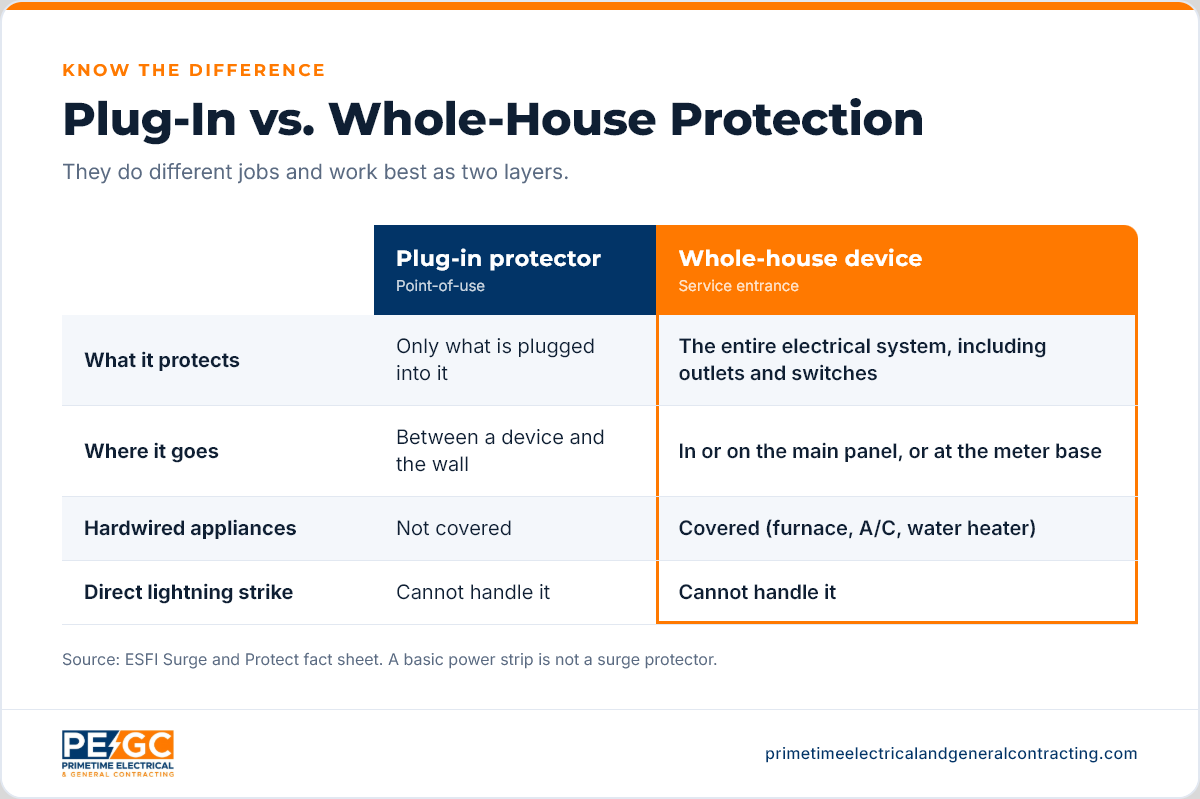
A whole house surge protector, formally called a surge protective device (SPD), is installed at your electrical service. ESFI describes service-entrance devices as mounted in or on the main panel or at the meter base, where they protect the entire electrical system, including outlets and light switches. A plug-in protector, by contrast, only protects what is plugged into it. For a technical walkthrough of how these devices work, see what a whole-house surge protector does.
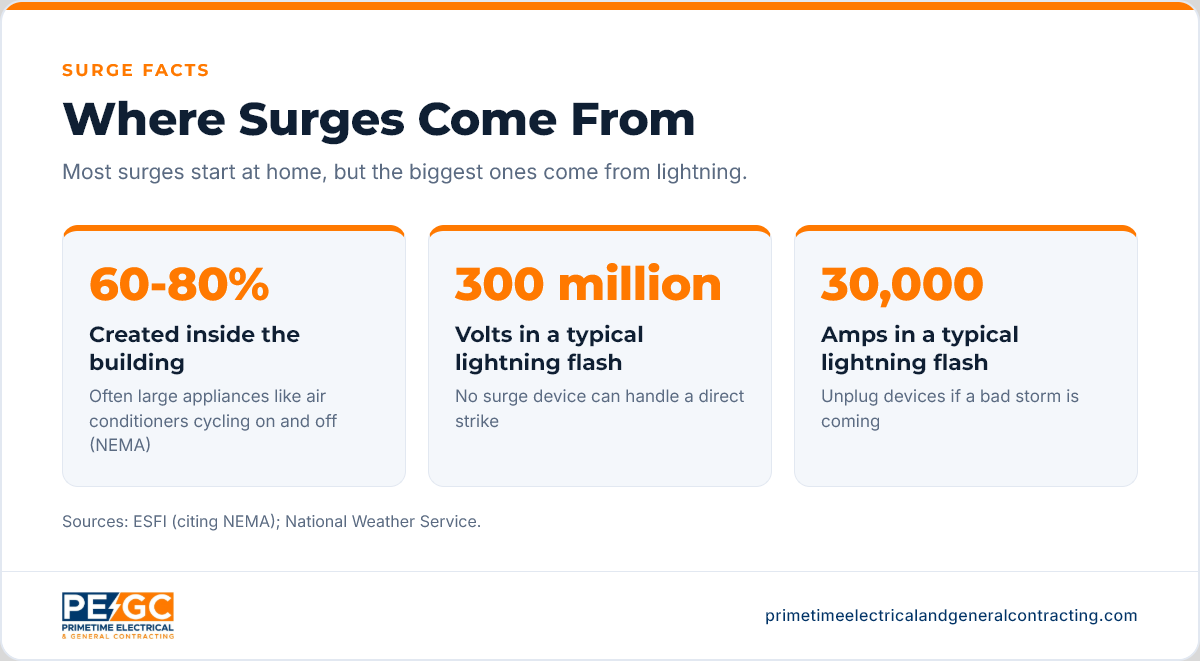
Here is the honest caveat: no surge protection device can handle a direct lightning strike. ESFI says so plainly, and the National Weather Service notes that a typical lightning flash carries roughly 300 million volts and about 30,000 amps. What a whole-house device does well is deal with the far more common surges that arrive through the power lines or start inside your own home. For those, it’s one of the better values in home electrical work.
Where surges really come from
When people picture a surge, they picture lightning. Lightning produces the most powerful surges, but it isn’t the most frequent source. The National Electrical Manufacturers Association (NEMA) estimates that 60 to 80 percent of surges are created inside a building, most often by large appliances such as air conditioners turning on and off. The rest come from outside, mainly from switching on the utility grid, and, less often, from lightning.
That has a few practical consequences for a Southeast Michigan home:
- Your own appliances cause small surges every day. Central air, the furnace blower, the sump pump, the water heater and the dryer all create small voltage disturbances when their motors or elements cycle. If your lights dim or flicker when the AC kicks on, that’s a related symptom, and we cover it in our guide to why lights flicker when the AC turns on.
- Storm season is real here. The National Weather Service office covering Detroit and Pontiac reports that tornado activity in Southeast Michigan peaks in June and that most tornadoes occur between April and August. Thunderstorms follow the same general season, so spring through summer is when your system is most exposed to line disturbances and outages.
- Power returning is a risk, too. When the grid switches, trips or restores power after an outage, voltage can spike on the way back. A whole-house device helps with that kind of event.
Whole-house vs. plug-in: what each one protects
The two types do different jobs, and they work best together rather than as substitutes.
Plug-in (point-of-use) protectors sit between a device and the wall. ESFI notes that they protect only what’s plugged into them, by diverting a surge to ground, and that the better ones have an indicator light or alarm that tells you when the unit needs replacing. One more thing worth knowing: a basic power strip is not a surge protector. Strips and extension-style suppressors add outlets, not protection capacity, so check the packaging.
Whole-house (service-entrance) devices go in or beside your main panel and take the first hit of incoming surges for every circuit. That means protection for hardwired items that you can’t plug into a strip at all: the furnace, the air conditioner, the water heater, the sump pump, the garage door opener, the doorbell transformer and the dishwasher.
The most sensible setup is layered. A whole-house device knocks the big surge down at the panel, and a quality plug-in protector handles whatever is left for your most sensitive electronics, like the home office and entertainment center.
What to look for in a whole house surge protector
You do not need to become an expert, but a few basics will help you compare options and ask better questions of your electrician.
- A UL 1449 listing. UL 1449 is the U.S. safety standard for surge protective devices. A listed device has been tested to it. If a unit isn’t listed, move on.
- The right type for the location. In general terms, Type 1 devices are installed on the line side of the main disconnect and Type 2 devices on the load side, in or beside the panel. Which one is appropriate depends on your panel and service, and that is a decision for your electrician.
- An indicator that tells you it’s working. Surge devices use up protective components over time. A status light or alarm lets you know when the unit has done its job and needs attention.
- A proper ground and a licensed installer. A surge protector diverts energy to ground. If the grounding at your service is poor, the device can’t do its job well. This is not a good DIY project, since the work happens inside or right beside your main panel.
On code, recent editions of the National Electrical Code have moved toward requiring surge protection on new dwelling-unit services and when service equipment is replaced. Which edition your township enforces varies, so ask your electrician or your local building department what applies to your address. Either way, you don’t need a code mandate to make it a smart upgrade.
What it costs and how to think about value
Pricing depends on the device, how accessible your panel is, and whether anything else needs attention at the same visit, so we won’t throw out a number that may not fit your house. A Free Quote after a quick look at your panel is the most reliable way to know what it would cost for your home.
To judge whether it’s worth it, add up what’s connected to your electrical system rather than comparing it to a single TV. Count the furnace, the air conditioner, the refrigerator, the washer and dryer, a computer or two, the TVs and a garage door opener. If one hardwired control board fails after a storm, the repair bill alone can approach or exceed what protecting the whole house would have cost. And because repeated small surges can quietly shorten appliance life, the protection also works in the background on days with no storm at all.
Signs your home may already be taking surge damage
You won’t always get a clear warning, but these are common clues that something is off:
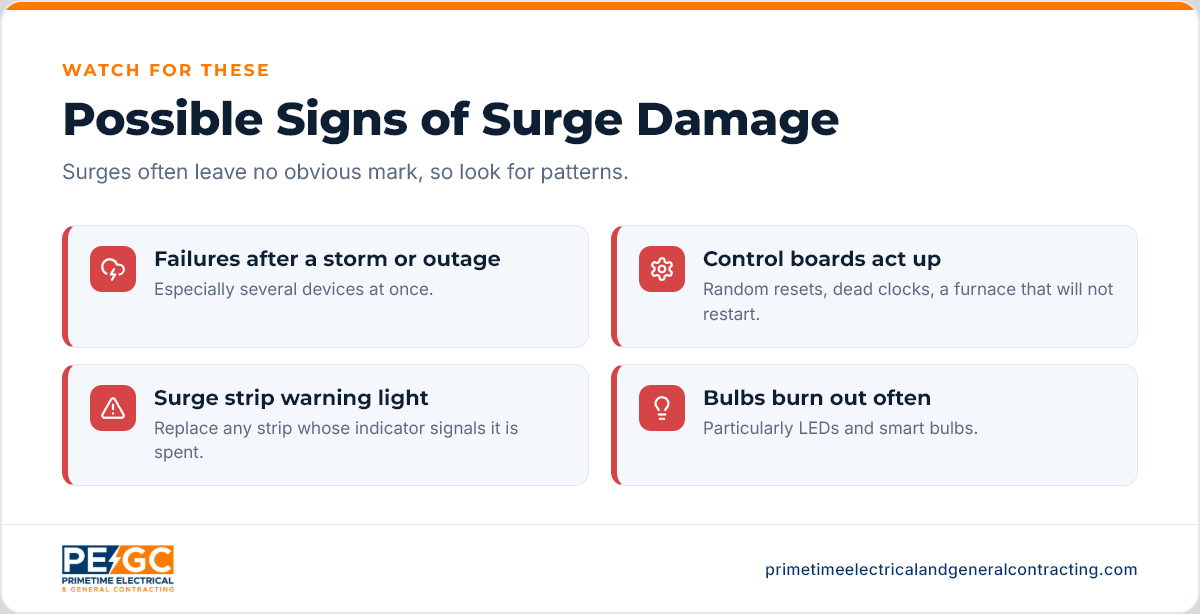
- Electronics or appliances fail after a storm or outage, especially several at the same time.
- Control boards and displays act up without an obvious cause: random resets, dead clocks, a furnace that won’t restart.
- Your surge strips show a warning light or have stopped protecting. Replace any that do.
- Bulbs burn out unusually often, particularly LEDs and smart bulbs.
- Breakers trip with no clear cause. That’s not always a surge problem, but it deserves a look. Our guide to why breakers keep tripping explains the usual causes.
While a storm is overhead, the safest approach is not to rely on any device. The National Weather Service advises staying away from corded phones and from touching electrical equipment such as computers, TVs and cords during a thunderstorm. If you know a bad one is coming, ESFI’s advice is to unplug sensitive devices.
When to call a licensed electrician
Because the device connects to your service equipment, this is a job for a licensed professional. Here is when we’d suggest picking up the phone:
- You’ve lost electronics or appliances to a storm or outage and want to prevent a repeat. Start with whole-house surge protection.
- Your panel is older, crowded or showing its age. It may be smarter to combine a surge device with an electrical panel upgrade. Not sure what size you need? Our 100-amp vs. 200-amp panel guide walks through it.
- You’re adding a generator. Backup power and surge protection pair well, since power transitions are exactly when voltage can misbehave. See our guide on sizing a whole-house generator.
- Something is clearly wrong. A burning smell, a hot panel or visible damage needs emergency electrician service, not a blog post.
We serve Sterling Heights and communities across Macomb and Oakland counties, including Warren, Clinton Township, Shelby Township and Macomb Township. You can see the full list on our service areas page.
Frequently asked questions
Will a whole house surge protector stop a direct lightning strike?
No. ESFI states that no surge protection device can handle a direct lightning strike. A whole-house device is designed to handle the much more common surges from the utility grid and from large appliances in your own home.
If I have a whole-house device, do I still need plug-in protectors?
It’s a good idea for valuable electronics. The whole-house unit reduces the big surge at the panel, and a point-of-use protector adds a second layer right at the device. Just make sure what you buy is a true surge protector and not a plain power strip.
Does a surge protector wear out?
Yes. Protective components in these devices can be used up by surges over time, which is why many have an indicator light or alarm. Check the indicator after storms and replace the unit when it signals you to.
Can I install one myself?
We don’t recommend it. The installation is made in or next to your main panel, where the service conductors are live and grounding matters. A licensed electrician can install it correctly and check your panel at the same time.

If you’ve lost electronics to a storm or simply want to protect what you own, call Primetime Electrical & General Contracting at (810) 397-2401 for a Free Quote.