

It’s the first humid week of July in Sterling Heights, the upstairs bedroom is stuffy, and you finally decide the old light fixture needs to become a ceiling fan. You open a browser, type in the question, and get prices ranging from “under $100” to “over $1,000.” That range is real, and it’s confusing, because the number that applies to your ceiling depends on a few things you can’t see from the floor.
So how much does it cost to install a ceiling fan in Michigan? For a straightforward swap on existing wiring, plan on roughly $150 to $350 for labor and basic materials. A brand-new fan location, where no light fixture existed before, can run several hundred dollars more. Below we’ll break down what drives the price, show you how to estimate your own job, and explain when it makes sense to bring in a pro for ceiling fan installation instead of climbing the ladder yourself.
The short answer: what ceiling fan installation costs
The most useful number to start with comes from Thumbtack, which puts the national cost of ceiling fan installation at about $146 to $351, with most homeowners paying around $225. That figure is for labor and typical installation, not the fan itself. Electricians nationally charge roughly $75 to $95 per hour, and some pros quote a flat fee for a basic job.
Prices for the Detroit area, based on online estimating sites, generally land in the same low-to-mid hundreds for a simple replacement and climb toward $700 when a new fan and new wiring are both part of the job. Those are aggregator estimates, not quotes, so treat them as a sanity check rather than a promise. A local electrician who has actually seen your ceiling will always be more accurate.
Here is how the work breaks down in practice:
- Swapping an existing fan or light fixture for a new fan: the lowest-cost scenario, typically the shortest job when the wiring and box are already in good shape.
- Installing a fan where there was no fixture: more labor, because someone has to run new cable and cut into the ceiling. Thumbtack lists new wiring at about $6 to $8 per foot.
- Adding a new circuit: the highest-cost scenario. Thumbtack puts a new circuit at about $130 to $290 on top of the rest of the job.

What actually changes the price
Two homes on the same street can get very different quotes for the same fan. These are the factors that move the number most.
1. Is there already a fan-rated box?
A ceiling fan is heavier than a light fixture, and it pulls and wobbles as it spins. That’s why the National Electrical Code requires ceiling paddle fans to be supported independently of the outlet box, or by a box that’s listed and marked for fan support. According to a code Q&A in EC&M magazine, based on the 2017 NEC, a box used as the sole support must be marked as suitable for ceiling paddle fan support of not more than 70 pounds, and for fans over 35 pounds the box must also show the maximum weight it can carry. Which edition of the code applies depends on your township, so we always check locally.
Why does this matter for your bill? Because a standard plastic or shallow metal box that was fine for a light is not a safe place to hang a fan. If your ceiling already has a fan-rated box, the job is quick. If it doesn’t, we have to replace the box and, in many cases, add support between the joists, which adds time and materials.
2. Where the box sits in the ceiling
ENERGY STAR notes that ceiling fans can weigh as much as 50 pounds, and that if a joist isn’t centered where the fan needs to go, you should use a special bracket with spiked ends installed between the joists. An off-center location is common when the old fixture was placed for looks rather than for structure. Reaching that spot, especially from a finished ceiling below, takes more labor.
3. Ceiling height and downrods
Tall or vaulted ceilings take more time and sometimes need special ladders or scaffolding. They may also call for a longer downrod so the blades hang at a useful height. Thumbtack lists a downrod at about $12 to $50 plus labor. A fan on a 9-foot or vaulted ceiling will almost always cost more to install than one on a standard 8-foot ceiling.
4. Wiring and switches
If you have a single switch controlling an old light and you want separate control for the fan and its light, that usually means more wiring or a different control. Remote kits and wall controls vary in price, and wiring for separate switches takes extra time. A fan with a built-in remote can often be installed without any change to the wall switch.
5. The fan itself
The fan is a separate purchase from the labor. Thumbtack’s price table shows standard fans running anywhere from about $30 to $1,200, and designer or specialty fans going well beyond that. Pick the fan first if you can, because its weight and size affect the box, the downrod and the mounting hardware we need.
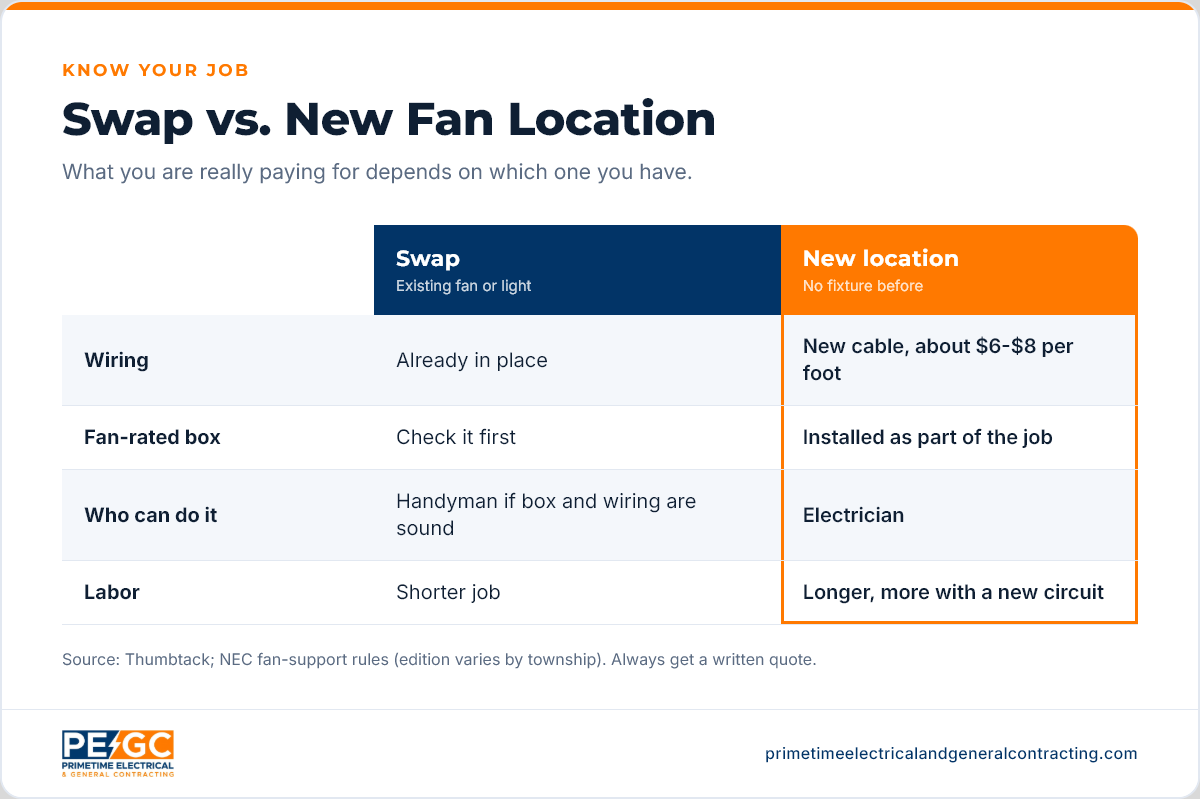
Swap or new install: which one are you doing?
Thumbtack’s guidance is a helpful way to think about it. A handyman can reasonably handle swapping one fan for another where the wiring and box are already in place. An electrician is the right call when a fan is going somewhere that never had one, when new wiring is needed, or when a new circuit has to be added.
In our experience in Macomb and Oakland counties, the swap is where homeowners most often get surprised. They plan on a quick afternoon, remove the old fixture, and find a box that isn’t rated for a fan, brittle insulation on the old wires, or no ground wire at all. At that point it stops being a simple swap. If you’re not sure what’s above your ceiling, the fastest way to find out is to have someone look before you buy a fan.
Michigan and Sterling Heights: what’s different here
Ceiling fans earn their keep in Michigan, even though our summers are shorter than in the South. Humid July and August stretches make second-floor bedrooms uncomfortable, and a fan helps a lot. The U.S. Department of Energy notes that a ceiling fan lets you raise your thermostat setting about 4°F with no reduction in comfort, which can add up over a cooling season.
Fans are useful in the cold months too. ENERGY STAR advises that in winter you reverse the motor and run the fan at low speed in the clockwise direction, which gently pushes the warm air near the ceiling back down into the room. With a long heating season, that’s a real benefit, especially in rooms with high ceilings. It also points out that fans cool people, not rooms, so turn the fan off when nobody is in the room.
Permits are another local detail. Requirements for electrical work vary by city and township, so a simple fan swap and a new circuit may be treated differently. A licensed electrician who works in your area every week will know what Sterling Heights, Warren, Clinton Township and the surrounding communities expect. You can see the full list of places we work on our service areas page.
Warning signs your fan or its wiring needs attention
Sometimes the reason to call is an existing fan, not a new one. Watch for these:
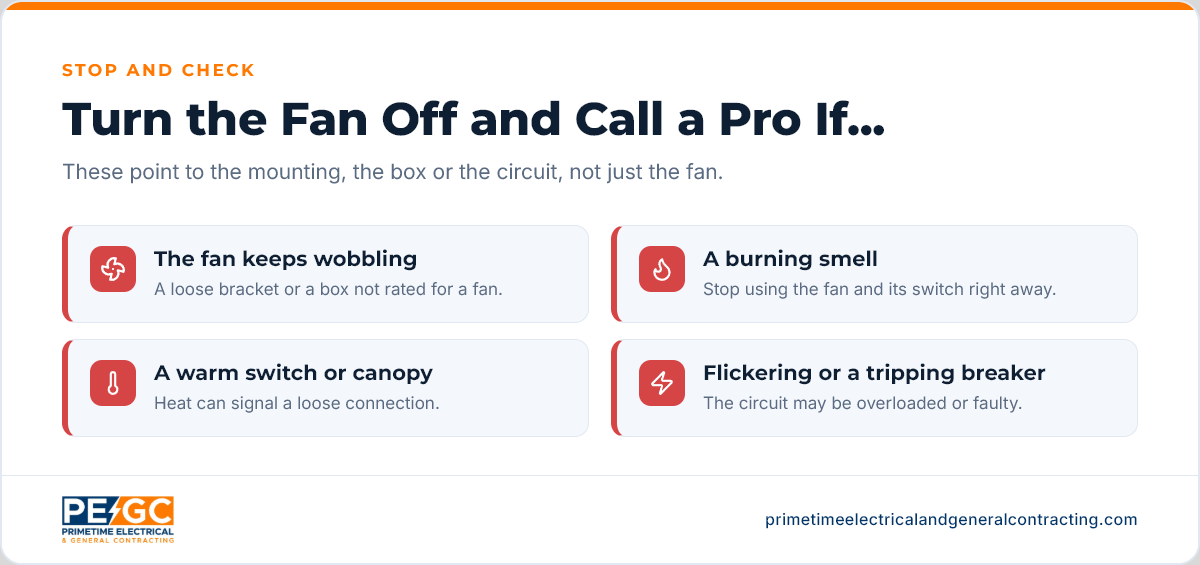
Wobbling is the most common complaint, and it’s often a loose mounting bracket or an unbalanced blade, not a wiring problem. A fan that keeps wobbling and is hanging from a box that isn’t fan-rated is a different story, because the fan can loosen over time. A warm switch, a burning smell, or flickering that comes and goes are signs to turn the fan off and have the circuit looked at. If your breaker is also acting up, our guide on why circuit breakers keep tripping can help you sort out what you’re seeing, and if lights dim when the AC kicks on, read why lights flicker when the AC turns on.
When to call a pro
You can absolutely hire a handyman to hang a fan on a properly rated box with existing wiring. Call an electrician when:
- You want a fan in a spot that has never had a light or fan.
- The existing box isn’t labeled for fan support, or you can’t tell what it is.
- You’re planning to add a switch, dimmer, or a separate circuit.
- The ceiling is vaulted, very high, or the attic isn’t easy to reach.
- You see aluminum wiring, cloth-covered wires, or no ground.
If you’re updating more than one room, it’s also a good time to look at the rest of the lighting. Our lighting installation team can add recessed lights or new fixtures in the same visit, which usually costs less than coming out twice.
Frequently asked questions
How much does it cost to install a ceiling fan in Michigan?
For a basic swap on existing wiring, expect roughly $150 to $350 for installation. Nationally, Thumbtack reports a range of about $146 to $351. A new location with new wiring, a new fan box, or a high ceiling costs more, so the best way to get an accurate number is to have an electrician look at the ceiling.
Does the fan cost extra?
Yes. The installation price covers labor and basic materials, and the fan is a separate purchase unless the installer supplies it. Thumbtack shows standard fans ranging from about $30 to $1,200.
Can I use any ceiling box for a fan?
No. A box that supports a fan must be listed and marked for that use, or the fan must be supported independently of the box. This is the National Electrical Code’s requirement for ceiling paddle fans, and it’s one of the main reasons we recommend having a pro check the box before the fan goes up.
Which direction should my fan spin in winter?
ENERGY STAR advises reversing the motor and running the fan at low speed in the clockwise direction in winter. Turn the fan off when the room is empty.

If you’re ready to add a fan, or you’ve opened a ceiling and found something you didn’t expect, call Primetime Electrical & General Contracting at (810) 397-2401 for a free estimate. We serve Sterling Heights and communities across Macomb and Oakland counties.