
It’s a cold evening in Sterling Heights. You’re halfway up a ladder with a strand of lights in one hand, you plug in the last section, and the breaker trips. Half the display goes dark, and so does the garage. Most people blame the lights. In our experience, the real culprit is almost always the circuit they’re plugged into.
So how many Christmas lights can you plug into one outlet? The honest answer is that it depends on the circuit, not the outlet, and you can work out your own limit in about two minutes. Below we’ll walk through the math, what changes with LED lights, why outdoor outlets behave differently, and when it’s time to stop adding extension cords and call a licensed electrician for outdoor lighting help.
The short answer: it’s the circuit, not the outlet
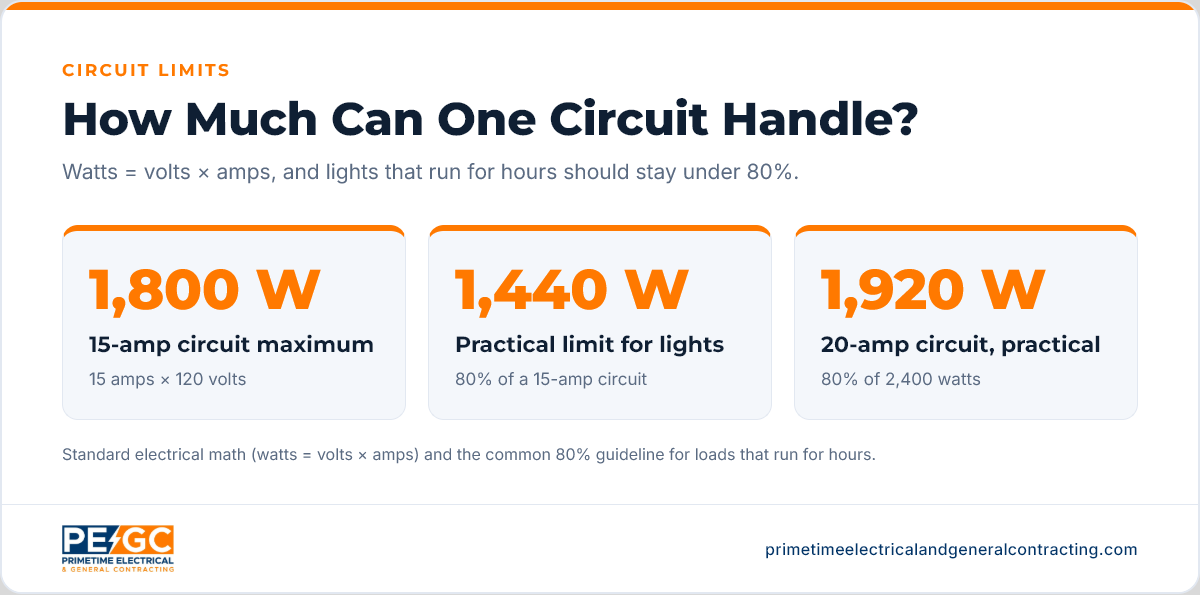
An outlet isn’t a power source on its own. It’s just a place to plug into a circuit, and that circuit is protected by a breaker in your panel. A standard 15-amp circuit at 120 volts can deliver a maximum of 1,800 watts (15 amps × 120 volts). A 20-amp circuit tops out at 2,400 watts.
Holiday lights usually run for hours at a time, and electricians generally plan for that kind of continuous load to stay at or below 80% of the circuit’s rating. That puts a practical ceiling of about 1,440 watts on a 15-amp circuit and about 1,920 watts on a 20-amp circuit.
Here’s the part that surprises people: several outlets can share a single breaker. The porch outlet, a garage outlet, and a bedroom outlet on the other side of the wall might all be on the same circuit. Everything plugged into any of them counts toward the same limit, including your inflatable snowman and the space heater in the garage.
How to calculate your own limit in four steps
You don’t need special tools for this. You need the labels on your lights and a calculator.
- Find the wattage on each light string. It’s printed on the tag near the plug or on the box. If the label lists amps instead of watts, multiply the amps by 120 to get watts.
- Add up everything on that circuit. Lights, inflatables, projectors, and anything else that shares the circuit all count.
- Compare the total to your circuit’s practical limit: roughly 1,440 watts for a 15-amp circuit, or 1,920 watts for a 20-amp circuit.
- Spread the load. If you’re over, move some strings to an outlet on a different circuit instead of daisy-chaining more cords.
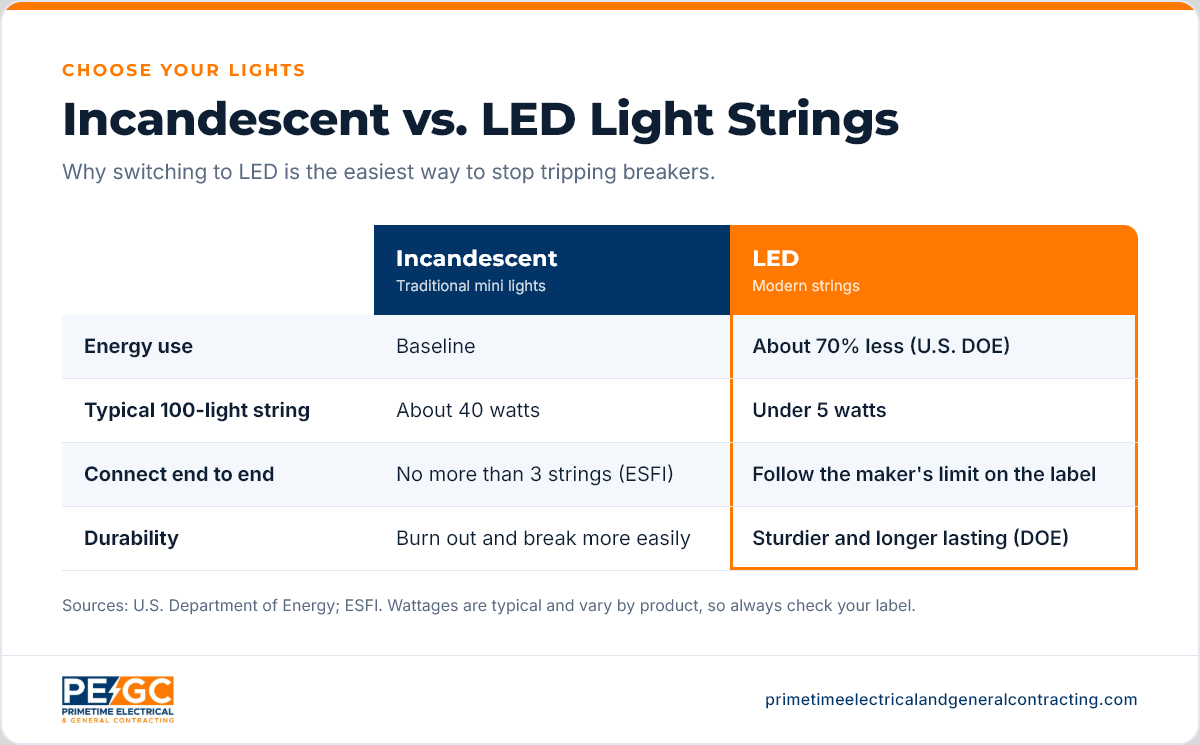
For a rough sense of scale, a typical 100-light incandescent mini string draws about 40 watts, so ten of them is around 400 watts. A comparable 100-light LED string draws under 5 watts, so the same ten strings is less than 50. Real numbers vary by product, so always trust the label over any rule of thumb, including ours.
LED vs. incandescent: what actually changes
Switching to LED is the single easiest way to stop tripping breakers. The U.S. Department of Energy says LED light strands use about 70 percent less energy than conventional incandescent strands, and they’re sturdier and far less likely to burn out or break.
There’s one more rule that matters, and it comes straight from the Electrical Safety Foundation International (ESFI): never connect more than three strings of incandescent lights end to end. More than that can blow a fuse or even cause a fire. For LED strings, the end-to-end limit is set by the manufacturer and printed on the box or tag, so follow it exactly, and never assume that because LEDs are efficient you can chain as many as you like.
Outdoor lights in Michigan: GFCIs, cords, and wet weather
Outdoor lighting adds a second layer of protection and a second way for things to trip. The National Electrical Code requires ground-fault circuit interrupter (GFCI) protection on outdoor outlets at homes. A GFCI doesn’t trip because you’ve plugged in too much. It trips when it senses current leaking where it shouldn’t, which is exactly what happens when sleet, wet snow, or a puddle gets into a plug connection.
ESFI’s guidance for outdoor displays is simple and worth following:
- Use only lights and extension cords that are marked for outdoor use.
- Plug outdoor lights into GFCI-protected outlets. If an outdoor outlet doesn’t have GFCI protection, that’s a sign it needs upgrading, and a portable outdoor GFCI is a stopgap in the meantime.
- Follow the manufacturer’s instructions that came with the lights.
Practical tip: keep plug connections up off the ground and out of snow and puddles. If your GFCI trips every time it snows, that’s the outlet doing its job, and it’s also a good reason to have us look at a GFCI outlet replacement or a better-protected outdoor outlet location.
Why breakers trip, and what not to do about it
When a breaker trips under a holiday-light load, it’s almost always an overload: too many watts on one circuit. Tripping is the breaker doing exactly what it was built to do. We covered the other common causes in our guide to why circuit breakers keep tripping.
The worst response is swapping in a bigger breaker. A breaker is sized to protect the wire behind it, and a larger one can let that wire overheat before anything trips. If a circuit can’t handle what you need, the fix is a different circuit, not a bigger breaker.
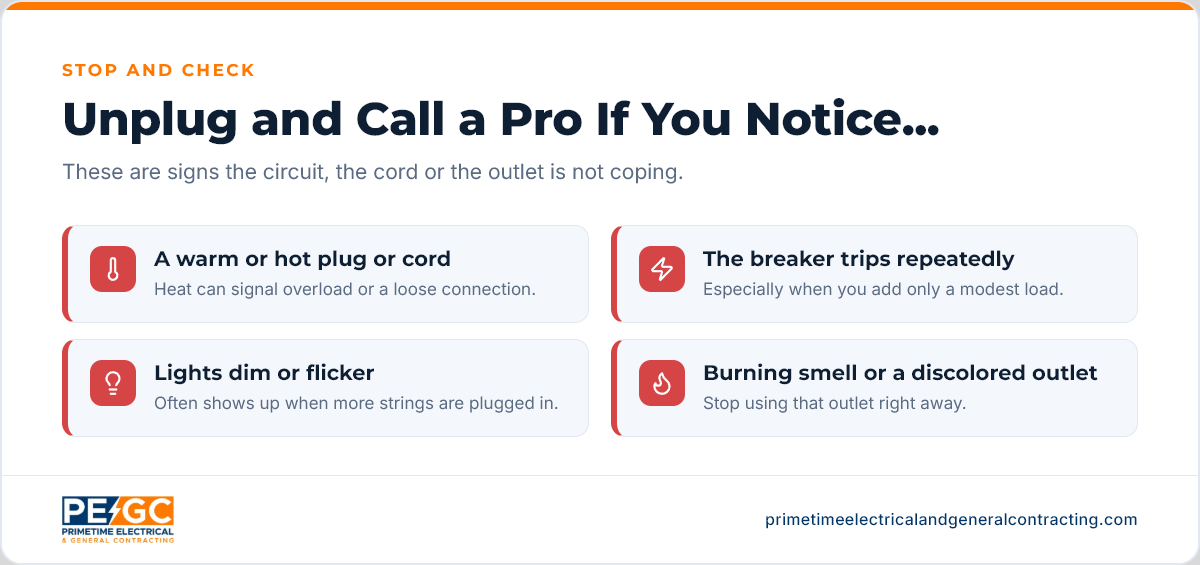
Unplug everything and call an electrician if you notice any of the following:
The fire-safety numbers worth knowing
The National Fire Protection Association (NFPA) reports that U.S. fire departments responded to an average of about 155 home fires caused by Christmas trees each year between 2018 and 2022. In NFPA’s latest analysis, electrical distribution or lighting equipment was involved in more than two in five of those fires. Those fires are rare, but they’re largely preventable with the habits above: check strings for damage before you hang them, don’t overload circuits, and use outdoor-rated equipment outside.
When it’s time to call an electrician
A few extension cords for a weekend display are fine. These are signs your house needs a better setup:
- You don’t have enough outdoor outlets. We can add GFCI-protected outdoor outlets where you actually need them, so you aren’t running cords through doors and windows.
- Breakers trip even with modest loads. That can point to an old or crowded panel. Our breaker and panel upgrade service handles that, and our 100-amp vs. 200-amp panel guide explains when a bigger service makes sense.
- You want a permanent display. Permanent lighting on its own circuit, controlled by a timer or smart switch, avoids the seasonal shuffle of cords and adapters. Need ideas? See these landscape lighting ideas for Michigan homes.
- Something feels off. If you can’t find the cause, electrical troubleshooting is what we do all day.
We serve Sterling Heights and communities across Macomb and Oakland counties, including Warren, Clinton Township, Shelby Township, and Macomb Township. You can see the full list on our service areas page.
Frequently asked questions
How many strands of LED lights can I connect together?
Follow the limit printed on the box or tag. It varies by product and is set by the manufacturer. For incandescent strings, ESFI says never connect more than three strings end to end.
Why does my outdoor outlet keep tripping when I plug in lights?
If it’s a GFCI outlet, moisture or a damaged cord may be causing a ground fault. Unplug everything, press RESET, and add strings back one at a time. If it trips again with nothing plugged in, or you can’t find the cause, call a licensed electrician.
Can I use an indoor extension cord outside?
No. ESFI advises using only extension cords and decorations marked for outdoor use when decorating outside.
Is it safe to leave Christmas lights on overnight?
Safest practice is to turn lights off when you go to bed or leave the house. A timer makes that automatic.

If your display keeps tripping breakers, or you’d rather not climb a ladder and cross your fingers, call Primetime Electrical & General Contracting at (810) 397-2401 for a free estimate.